
Intensive Outpatient Programs

Women's Recovery Program

Men's Recovery Program

Family Support Program
Our IOP Recovery Program is built on decades of clinical experience and is structured around three progressive phases over the course of a full year, with each phase intentionally designed to build upon the last.
While our program is structured, it is also personalized to support each individual’s unique journey. In practice, we operate much like a concierge model of care – our clinicians are not only highly experienced, but deeply attuned and available to the needs of each client. They think therapeutically and collaboratively about how to support each person’s growth across each phase of treatment.
Throughout the length of the program, each individual has dedicated clinical support for each phase of treatment. This consistent therapeutic relationship allows for trust, continuity, and a deep understanding of each client’s personal history, challenges, and goals.
Our counselors are also highly accessible, offering clients the ability to reach out for support in times of need. This open line of communication is a unique and intentional aspect of our program that allows us to provide a deeper level of support.
Phase I: Intensive Outpatient Substance Use Treatment
Phase I is where the foundation for meaningful and lasting recovery begins. This phase of the program lasts two months and is where clients receive the most consistent and structured support, as this is often when individuals feel the most vulnerable and in need of connection, stability, and guidance.
Built on the “four sturdy legs of the chair” — Support, Structure, Accountability, and Tools—this phase helps clients find their footing and begin to shift their relationship with substances. Participants attend three weekly group sessions designed to build awareness by exploring the roots of their substance use with honesty and curiosity. It is also a time when group members lean on the strength of one another and support each other through the challenges that can arise in early sobriety.
During this phase, clients attend four weekly Mindfulness Based Relapse Prevention sessions to strengthen regulation and resilience, and begin to build an observer perspective that is integral to much of the IOP curriculum. Clients in this phase also attend two monthly IOP Wellness classes that provide additional support and stability through educating each member on the biological aspects of substance dependence and early sobriety. Clients exit Phase 1 with a sturdy foundation to steadily navigate the early stages of recovery.

Phase II: Continuing Care
After establishing stability, clients transition into continuing care sessions. Here, the focus shifts toward practicing new behaviors in daily life and deepening awareness of the habitual and emotional drivers behind substance use. Clients often find a deeper sense of self compassion and emotional healing in this phase of treatment, and in turn, use this new connection to cultivate a life that no longer has room for substances.
During this phase, participants attend monthly Wellness groups to reinforce their skills to manage cravings, reduce relapse risk, and strengthen self-awareness. Polyvagal sessions are also introduced in a 4-week program that draws from Polyvagal Theory, which explores how our nervous system responds to stress and safety. By understanding these patterns, participants can learn practical ways to calm the body, regulate emotions, and build resilience in recovery.

Phase III: Resolve Enhancement and Alumni Community Support
With a strong foundation in place, clients focus on skill-building and long-term growth and recovery. Individual counseling (approximately once a month) allows for personalized support based on the clients needs.
Clients learn to integrate recovery into everyday life, strengthening the “muscles” of self-awareness, accountability, and healthy coping strategies. The emphasis is on practice and reinforcement—moving from insight to lived experience.

Client-Driven Abstinence- Practice in Action
With a strong foundation in place, clients focus on skill-building and long-term growth and recovery. Individual counseling (approximately once a month) allows for personalized support based on the clients needs.
Clients learn to integrate recovery into everyday life, strengthening the “muscles” of self-awareness, accountability, and healthy coping strategies. The emphasis is on practice and reinforcement—moving from insight to lived experience.
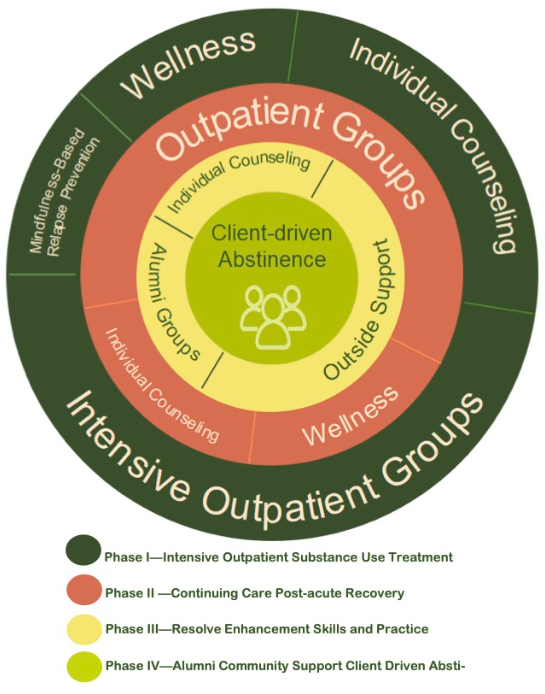
Learn more about the additional classes in our Recovery Program for IOP that include wellness, mindfulness, and polyvagal theory.
“The combination of structured and flexible group environment was great—the understanding and flexibility of the counselor (and program) which allowed incorporation of real life needs with the group needs.”
Female, 41